



How can manufacturing teams identify and reduce production losses before they become costly? The answer lies in implementing continuous improvement practices—but not all businesses have time for deep analysis during busy production phases. That’s where Short Interval Control (SIC) comes in.
SIC empowers teams to review real-time performance data throughout the shift, allowing for immediate course correction and measurable performance gains. In this article, we’ll explore what Short Interval Control is, how it works, and how it supports LEAN production in sectors such as manufacturing, mining, and beyond.
What is "Short Interval Control (SIC)"?
Short Interval Control (SIC) is a structured continuous improvement method rooted in Kaizen principles. It involves conducting quick, focused reviews of performance data multiple times per shift. These mini-reviews allow teams to address minor inefficiencies in real time before they escalate into major losses.
The goal of SIC is to convert performance insights into immediate, actionable improvements—thereby enhancing shift-level productivity, increasing accountability, and building a culture of continuous improvement.
The role of Kaizen in SIC
SIC aligns with the broader philosophy of Kaizen, a Japanese approach to improvement that values small, consistent changes over time. While Kaizen initiatives are often long-term and company-wide, SIC provides a short-loop execution method that fits neatly into daily operations.
In a LEAN organisation, this approach encourages every employee—not just leadership—to take responsibility for identifying and resolving production challenges.
How short Interval control works
SIC revolves around short, scheduled meetings that happen during the production shift. These 5–10 minute discussions are typically held close to the production line, allowing the team to make real-time decisions based on what’s happening at that moment.
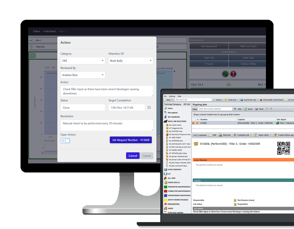
Using tools like MaintMaster OEE, teams can quickly access real-time data, track key metrics, and log actions directly into their performance systems. This helps make reviews fast, fact-based, and focused.
Running an effective SIC meeting
Each meeting is guided by a consistent structure and a small team of cross-functional representatives. This usually includes:
-
Lead operators or production team leads
-
Line supervisors or shift managers
-
Maintenance technicians
-
Process or quality engineers
The team reviews data from the current and previous intervals to understand what’s working and where intervention is needed. The aim is not to solve every problem immediately but to identify actionable next steps for improvement.
Standard SIC agenda: The 4-step format
To keep the process streamlined, meetings typically follow this simple four-part format:
-
Review Previous Losses
Discuss what went wrong in the last interval. Which performance losses were most impactful? -
Assess Previous Actions
Did the last set of improvements have the intended effect? What lessons were learned? -
Identify Next Risks
Consider upcoming shifts, changeovers, material deliveries, or known equipment issues. -
Decide on Next Actions
Finalise a short list of priority actions and assign responsibilities for the next interval.
Benefits of Short Interval Control
When properly implemented, SIC delivers measurable improvements across every area of production:
Real-time visibility
SIC provides shift-level awareness of performance, allowing managers to stay on top of emerging problems.
Data-driven decisions
Rather than guessing or relying on intuition, teams make informed decisions based on live performance metrics.
Continuous improvement
SIC embeds improvement into daily routines—not just quarterly projects—making it easier to sustain over time.
Higher employee engagement
SIC creates ownership by involving operators directly in problem-solving and target-setting.
Better communication across shifts
Documented reviews help teams understand what happened before their shift and prepare for what’s coming next.
Common pitfalls and how to avoid them
While SIC is highly effective, poor implementation can limit its value. Watch out for:
- Meetings That Run Too Long
Keep meetings to 10 minutes max. If more time is needed, schedule a follow-up session. - Vague or Untracked Actions
Every action should be logged, assigned, and reviewed. Use a digital system for traceability. - Lack of Leadership Buy-In
It works best when senior leaders champion the process and model the behaviour they expect from teams. - Incomplete or Delayed Data
Without real-time visibility, SIC becomes reactive. Use MaintMaster OEE to feed live data into your review process.
Getting started with Short Interval Control
Start simple with your meetings:
-
Choose a pilot line or production area
-
Define your review intervals (e.g. every 2 hours)
-
Assign team members and train them on the format
-
Use real data to track progress
-
Gradually expand the process across shifts and departments
You don’t need to overhaul your entire system—just start with one team, one interval, and one goal. As small improvements accumulate, your entire operation will benefit.
How MaintMaster OEE strengthens SIC
SIC thrives on timely, reliable data. MaintMaster OEE integrates seamlessly into your process by:
-
Automatically capturing downtime, performance, and quality metrics
-
Visualising data for each shift or machine
-
Enabling operators to log causes and actions quickly
-
Generating trend reports for continuous improvement tracking
-
Linking directly to CMMS or ERP systems for cross-functional transparency
With MaintMaster OEE, your meetings shift from anecdotal to analytical—powering faster decisions and measurable outcomes.
Short Interval Control is a practical, scalable method for building continuous improvement into the fabric of your production process. By combining real-time insights, short meetings, and team ownership, SIC enables faster responses, fewer disruptions, and better overall performance.
Whether you're a LEAN veteran or just starting your improvement journey, combining SIC with MaintMaster OEE gives you the tools to act faster, operate smarter, and outpace your competition.