


Overall Equipment Effectiveness (OEE) is the gold standard for measuring manufacturing productivity. A high OEE score represents efficient use of equipment, minimal downtime, optimal speed, and high-quality output. But what does World Class OEE mean—and is it achievable?
In this guide, we explore what constitutes a world class OEE score, why it matters, and how manufacturers can set realistic goals and improve performance over time.
What is world class OEE?
World class OEE refers to a benchmark OEE score that reflects exceptionally high manufacturing efficiency. An OEE score of 100% means perfect production, only good parts, manufactured as quickly as possible, with zero downtime. In practice, however, 85% is widely accepted as the standard for world class OEE, especially in discrete manufacturing.
That said, very few manufacturers reach this level. Most operate between 40% and 60%, which is normal but leaves substantial room for improvement.
Understanding the three pillars of OEE
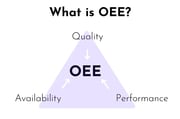
OEE is a product of three fundamental factors:
Availability
This measures the percentage of scheduled time that equipment is available to operate. It accounts for unplanned stops (like breakdowns) and planned stops (such as changeovers or maintenance).
Performance
This factor measures whether equipment is running at its ideal cycle time. Any slowdowns, small stops, or reduced speed events lower the performance score.
Quality
This assesses the proportion of good units out of the total produced. Any defective or reworked items reduce your quality score.
OEE Formula:OEE = Availability × Performance × Quality
Even high scores in each area can result in a lower total OEE. For example, scoring 90% in each component results in an OEE of just 73%.
Here you can learn more about the definition on OEE and how it is calculated
The origins of the world class OEE benchmark
The 85% benchmark was introduced by Seiichi Nakajima, the founder of Total Productive Maintenance (TPM) at the Japanese Institute of Plant Maintenance in the 1970s. According to Nakajima:
-
10% of time was lost to changeovers
-
5% was lost to performance inefficiencies
-
1% accounted for quality defects
-
Resulting in 85% OEE for companies with no breakdowns
These companies were awarded the prestigious Distinguished Plant Prize and were considered world class. However, this metric was developed within a specific context and may not be applicable across all industries or operational environments.
Is world class OEE realistic?
Whether 85% is attainable depends largely on your industry and production environment.
-
High-volume, low-mix manufacturers (e.g. food processing) can often achieve OEE scores closer to world class due to consistent products and fewer changeovers.
-
Low-volume, high-mix manufacturers (e.g. custom parts, medical devices) may prioritise flexibility over speed, resulting in lower OEE scores.
At Maintmaster, we work with a mindset of continuous improvement. With our real-world experience and software, we support you on your journey to achieving a World Class OEE score.
3 steps to set the right OEE target
Setting a realistic and motivating OEE target is essential for continuous improvement. Here are a few strategic approaches:
Step 1 - Set Baseline-Informed daily targets
Use your best historical OEE performance as a baseline, then aim to meet or exceed it daily. This encourages steady progress without unrealistic expectations.
Step 2. Use Pass/Fail thresholds
Set targets that allow for occasional misses. This helps identify outliers and low-performing shifts while maintaining high standards.
Step 3. Align OEE goals to asset criticality
Focus OEE improvements on equipment that is business-critical, where poor performance has the most impact on productivity, quality, or customer delivery.
How to start improving OEE
Achieving higher OEE begins with accurate measurement, meaningful analysis, and strategic action. Here’s how:
- Measure OEE With the Right Tools
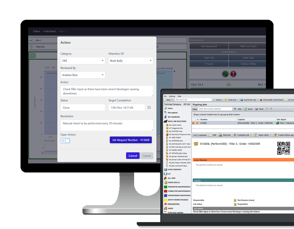
Use OEE software like Maintmaster OEE to automate data collection and provide real-time, accurate insights into availability, performance, and quality. This enables faster root cause analysis and better decision-making. - Prioritise Critical Equipment
Identify machines that are most essential to your business. Prioritise improvements on these assets to drive the biggest gains. - Reduce Downtime through smart maintenance
Not all downtime can be avoided, but much of it can be planned and controlled. With Maintmaster CMMS, you are able to to have a seamless integration between your OEE system and CMMS and get live reporting. - Focus on the Six Big Losses
The “six big losses” framework introduced in TPM is still one of the best tools for diagnosing and addressing productivity losses:
- Equipment Breakdowns (Unplanned Stops)
- Setup and Adjustment Time (Planned Stops)
- Minor Stops (Micro Stoppages)
- Reduced Speed (Slow Cycles)
- Reduced Yield (Start-up Rejects)
- Process Defects (Production Rejects)
- Equipment Breakdowns (Unplanned Stops)
Reducing or eliminating these losses is the key to boosting your OEE score over time.
Use OEE as a tool
What matters is using OEE as a tool to drive continuous improvement tailored to your unique operations.
At Maintmaster, we help manufacturers track, understand, and improve their OEE with the latest software and data-driven strategies. Whether your target is 45%, 60%, or 85%, we’ll support your journey every step of the way.