


When it comes to implementing OEE software, manufacturers face a critical decision: should you build an in-house solution or buy a specialised system from an expert provider?
While building may appear to offer control and cost benefits, the risks and hidden costs are often underestimated. In this article, we explore the key considerations that manufacturers must evaluate before choosing to build OEE software internally.
Why OEE software matters
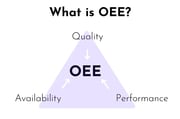
OEE (Overall Equipment Effectiveness) software helps manufacturers monitor and improve performance by accurately measuring availability, performance, and quality on the shop floor. The goal is not just to calculate OEE, but to gain real-time insight into operational inefficiencies and act on them to boost productivity.
At Maintmaster, we work with leading manufacturers worldwide to deliver robust OEE software solutions like Maintmaster OEE, designed to reduce costs, increase capacity, and drive continuous improvement.
Buy vs Build: A crucial business decision
For organisations with internal IT teams, the temptation to develop custom OEE software in-house is understandable. However, this approach comes with serious trade-offs in terms of cost, time, expertise, and risk.
Let’s explore the main factors you need to consider.
1. Cost of development, maintenance, and support
While it may seem cost-effective to use internal developers already on the payroll, in reality, building OEE software in-house is often more expensive over the long term. Consider the following:
-
Developers must be trained, and time spent coding means time not spent on core business projects.
-
Maintenance becomes a continual overhead, especially when staff turnover removes institutional knowledge.
-
Without a fixed project scope, costs can spiral beyond initial estimates.
In contrast, buying a proven OEE solution means predictable costs, pre-built functionality, and vendor support.
2. Time to deployment
In-house development projects often face lengthy delays due to complex planning, lack of dedicated resources, and shifting requirements.
A packaged OEE solution like Maintmaster OEE can be configured and deployed rapidly, sometimes in weeks rather than months. This ensures your manufacturing team starts capturing performance data and delivering ROI much sooner.
3. Skill set limitations
Technology skill sets evolve rapidly but most internal IT teams lack the deep domain expertise needed to build and maintain world-class OEE software.
-
Can your team keep up with shifts in manufacturing best practices?
-
Will they understand the needs of both discrete and continuous processes?
-
Do they have experience with condition monitoring, downtime tracking, or real-time alerts?
Specialist OEE software providers have years of experience embedded in their solutions. They evolve their platforms continuously, offering you future-ready capabilities without the need to retrain your team.
4. Focus on core business
Your primary focus is manufacturing, not software development.
By buying a packaged OEE system, your internal teams can continue improving production, customer service, and product quality, instead of being diverted into lengthy IT projects.
Leave the software development to those who specialise in it, so you can focus on what you do best.
5. Long-term maintainability
One of the biggest hidden risks in building your own software is long-term support. What happens when:
-
The original developer leaves the company?
-
You upgrade your production systems or ERP?
-
You need to integrate with new technologies or third-party systems?
Custom-built software is often poorly documented and hard to update. A vendor-supported application is continuously maintained, tested, and improved—reducing risk and avoiding technical debt.
6. Integration capabilities
Modern factories rely on an ecosystem of systems—MES, SCADA, CMMS, ERP. Will your in-house solution:
-
Integrate seamlessly with your production and business platforms?
-
Support data exchange in real-time?
-
Scale as your operations grow?
Commercial OEE solutions are designed for integration, offering out-of-the-box connectivity with a broad range of systems, which saves time and ensures accurate data flow. And when you choose Maintmaster OEE as your solution, you’re able to utilise the best of both worlds by integrating it with Maintmaster CMMS.
7. Functionality and future-proofing
A reputable OEE software provider works with hundreds of manufacturers and understands evolving market needs. Features like:
-
Multi-process support (discrete, batch, and continuous)
-
Real-time dashboards and KPIs
-
Root cause analysis
-
Predictive maintenance insights
-
Cross-site benchmarking
And are built in based on industry experience, not internal guesswork. When you build OEE software, you risk locking into outdated designs and missing opportunities for innovation.
8. Process improvement and best practices
In-house solutions often mimic existing (and potentially outdated) processes. External providers, on the other hand, bring best practice methodologies and years of practical OEE knowledge.
They don’t just provide software—they provide a pathway to measurable improvements.
9. Risk of failure
Large-scale internal development projects carry a high risk of failure. Common pitfalls include:
-
Vague project objectives
-
Poor planning or project scope creep
-
Lack of user engagement
-
Inadequate executive support
-
Budget and time overruns
With a packaged OEE platform, you're buying into a system that has already been tested, proven, and adopted by other successful manufacturers.
10. Faster time to value
Market conditions change rapidly. A solution that takes a year to build may already be obsolete by the time it's complete.
Buying OEE software accelerates your time to value, so you start seeing improvements in performance, efficiency, and decision-making almost immediately.
11. Documentation and knowledge retention
Comprehensive documentation is often neglected in internal projects, but it's vital for system maintenance and future scalability.
With a packaged solution, all technical and user documentation is provided—ensuring smooth onboarding, training, and updates, even if your internal team changes.
Will in-house software actually improve OEE?
It’s not enough to just calculate an accurate OEE score. World class OEE software should also help you improve it.
That means generating the right insights, triggering the right actions, and supporting continuous improvement across your organisation.
If you build software internally, ask yourself:
-
Do we have the internal manufacturing expertise to improve OEE, not just measure it?
-
Can we deliver software that adapts with our evolving business needs?
-
Will it guide users to take the right decisions at the right time?
Buy smart. Build only if you must.
Building OEE software may seem attractive at first glance, but in most cases, it’s slower, costlier, and riskier than buying a reliable, purpose-built solution.
If your organisation needs:
-
A scalable, reliable platform
-
Fast time to deployment
-
Proven results
-
Access to OEE expertise
-
Seamless integration with your existing systems
…then buying is the smarter choice.