
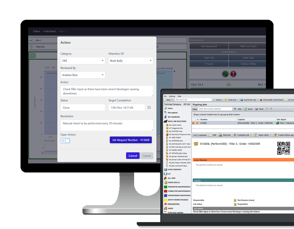



In the contemporary manufacturing landscape, data collection forms the cornerstone of effective decision-making. Machine data monitoring provides real-time insights into operational performance, enabling manufacturers to prevent avoidable production losses and implement impactful improvements.
What is "Machine Data Monitoring"?
Machine data monitoring refers to the automated collection, storage, and analysis of data generated by equipment on the shop floor. The data typically includes metrics such as cycle time, downtime, temperature, pressure, tool wear, and performance efficiency.
Unlike manual data entry, which is prone to human error and delays, modern machine monitoring uses a combination of:
-
Sensors and IoT devices installed on machinery
-
Edge devices or gateways to process and transmit data
-
Analytics and dashboard software to visualise and interpret data in real time
Together, these elements form a powerful system capable of driving smarter, faster, and more accurate decision-making.
How do machine monitoring systems work?
At their core, these systems collect real-time data through sensors, which are then processed by analytics software to:
-
Track performance against historical benchmarks
-
Monitor conditions for predictive maintenance
-
Generate alerts and notifications
-
Provide insights on OEE (Overall Equipment Effectiveness)
Machine data is typically visualised in user-friendly dashboards, accessible to operators, engineers, and plant managers. Interfaces can be machine-mounted or remotely accessible via mobile devices, giving teams instant feedback on the shop floor.
Key benefits of machine data monitoring
1. Real-time visibility
Gain immediate insight into the status of every machine. Identify and resolve issues before they cause costly downtime.
2. Predictive maintenance
Use machine learning to forecast when equipment is likely to fail. Plan maintenance activities to minimise unplanned stoppages.
3. Process optimisation
Analyse data trends to reduce cycle times, eliminate bottlenecks, and enhance throughput without compromising quality.
4. Reduced waste
Detect inefficiencies and idle time. Use data to streamline changeovers and eliminate unnecessary steps in your processes.
5. Enhanced product quality
Track variables that affect product consistency, such as vibration and temperature. Maintain tighter quality control through real-time monitoring.
6. Operator accountability
Operators can contribute contextual data, helping to bridge the gap between human and machine inputs and improving the reliability of insights.
Use cases across industries
Machine data monitoring has proven applications across various industries:
-
Automotive: Real-time OEE tracking and predictive maintenance for robotic arms and welding tools
-
Pharmaceutical: Monitoring environmental conditions and production consistency for compliance
-
Food & Beverage: Ensuring optimal temperatures and sanitisation compliance during production
-
Aerospace: High-precision monitoring of tool wear and feed rates in CNC machining
-
Electronics: Tracking micro-variations in equipment to prevent yield loss in assembly lines
Overcoming implementation challenges
While machine monitoring offers significant benefits, implementation must be approached strategically.
Common challenges:
-
Legacy equipment may lack built-in connectivity, requiring retrofitting with sensors and gateways
-
Data overload can overwhelm teams if not managed through intelligent filtering and prioritisation
-
Resistance to change from staff unaccustomed to data-driven decision-making
-
Security concerns related to cloud connectivity and IoT infrastructure
Solutions:
-
Start with a pilot programme on a single production line
-
Choose scalable software with customisable dashboards
-
Provide ongoing training and support to foster adoption
-
Work with a vendor experienced in Industrial IoT (IIoT) integration and data security
The role of machine monitoring in OEE optimisation
OEE (Overall Equipment Effectiveness) is a gold-standard metric in manufacturing performance. Machine data monitoring directly feeds into OEE measurement by providing accurate data for:
-
Availability: Tracking unplanned and planned downtime
-
Performance: Measuring cycle time against ideal benchmarks
-
Quality: Counting scrap and yield with real-time part tracking
Tools like Maintmaster OEE take this further by integrating with CMMS platforms to create automatic work orders and provide actionable suggestions for maintenance and line efficiency.
Future trends in machine data Monitoring
The evolution of machine monitoring will be shaped by several emerging technologies:
-
AI-Driven Diagnostics: Autonomous systems capable of identifying root causes of inefficiencies
-
Augmented Reality (AR): Overlaying data onto machines via smart glasses for on-site troubleshooting
-
Digital Twins: Creating virtual replicas of machines for simulation, forecasting, and real-time mirroring
-
Blockchain Integration: Ensuring secure, immutable records of machine performance and maintenance history
-
Sustainability Tracking: Measuring energy usage and emissions to support ESG reporting
Machine data monitoring is no longer just a technological advantage—it's a strategic necessity. In a world driven by data, manufacturers who harness real-time insights will lead in productivity, cost control, and quality assurance.
From the shop floor to the boardroom, machine monitoring empowers teams to act with clarity and confidence. By investing in the right systems, manufacturers not only protect their bottom line—they shape the future of smart, sustainable manufacturing.