



Understanding your production cycle time is fundamental to improving Overall Equipment Effectiveness (OEE) and delivering operational excellence. At Maintmaster, we believe tracking cycle time is not only vital for internal efficiency but also for customer satisfaction, resource planning, and lean manufacturing.
Knowing how long your production process takes—from start to finish—enables you to calculate lead times, optimise raw material flow, improve throughput, and set realistic delivery expectations for your customers.
What is "Production Cycle Time"?
Cycle time refers to the time taken to produce one unit or complete a production process from beginning to end. It’s often used to assess the speed and efficiency of manufacturing operations.
There are two common approaches to measuring it:
-
Effective Cycle Time: Measures the time from when work begins at one station to when it moves to the next—this includes waiting, changeovers, and set-up time.
-
Equipment Cycle Time: Focuses only on the time the machine actively works on the product—excluding changeovers or idle time.
Which metric you use depends on your specific operational goals. Establishing one or both as KPIs helps production managers track true job duration and eliminate guesswork.
Key cycle time definitions
You may encounter several related terms when working with cycle time metrics. Here's a quick overview:
-
Non-value-added time: Time spent on tasks that don’t directly add value from the customer’s point of view.
-
Operator cycle time: Time it takes for a human operator to complete a process manually.
-
Order lead time: Total time from receiving the order to customer delivery—including production and shipping.
-
Processing time: Pure time spent actively working on the order, excluding waiting or transport.
-
Order-to-cash time: Time between order placement and when payment is received.
-
Takt time: The rhythm at which a product needs to be completed to meet customer demand.
Selecting the right metric—or combination—allows you to improve planning, reduce waste, and meet production goals more effectively.
Why is calculating cycle time important?
Knowing your manufacturing cycle time offers multiple business advantages:
Better customer satisfation
Accurate cycle times allow you to provide reliable delivery estimates, boosting trust and improving your customer relationships.
Improved workforce planning
Over-promising delivery dates puts unnecessary strain on employees. Understanding realistic cycle times enables achievable workloads and better morale.
Lower costs
Shorter cycle times improve productivity and reduce operational costs. Adopting lean practices can eliminate waste and increase equipment utilisation.
More accurate project scoping
Visibility into actual production durations allows better quoting and planning, improving project delivery and profitability.
Competitive advantage
Businesses with shorter cycle times can deliver products faster—giving them a distinct advantage in industries where speed matters.
How to calculate cycle time
The basic formula for per-unit production cycle time is:
Cycle Time = Net Production Time ÷ Number of Units Produced
For example, if it takes 500 minutes to produce 1,000 units, your cycle time is:
500 ÷ 1,000 = 0.5 minutes per unit
Be sure to exclude non-production activities like breaks, inspections, and tool changes from net production time. Also consider changeovers when calculating batch or order-level cycle time.
What Is cycle time loss?
Cycle time loss refers to delays or inefficiencies that prevent equipment from performing at its expected output rate.
Manufacturers often compare actual cycle time to the manufacturer's benchmark (ideal cycle time) to identify where losses are occurring. The difference between these two times indicates performance loss—a key component of OEE.
How to reduce cycle time
Reducing production cycle time involves both process improvement and smart tools. Here are proven methods:
Use real-time monitoring tools
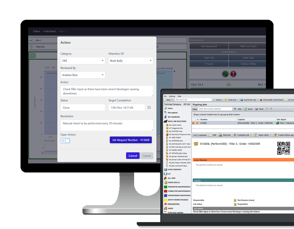
With Maintmaster OEE, you can collect and analyse cycle times continuously. This ensures you're using real data—not estimates—to inform decisions.
Measure with precision
Go to the shop floor and time processes manually or digitally. Start when the first operation begins and stop when the product is ready for the next step or shipment.
Visualise your data
Maintmaster OEE provides intuitive dashboards and automated reporting, enabling managers to track performance trends and benchmark against ideal times.
Automate calculations
Rather than relying on spreadsheets and manual input, software like Maintmaster OEE delivers on-demand analytics without the risk of human error.
Maximising your team’s time and performance
Production cycle time is more than just an efficiency metric—it's a reflection of how well you understand your operations and your ability to meet customer expectations. When cycle times are accurately tracked and clearly understood, you can make reliable delivery promises without putting unnecessary pressure on your team.
By grounding expectations in real data, you reduce stress, improve employee satisfaction, and enhance overall productivity. In turn, this builds trust—internally with your team and externally with your customers.
For manufacturers looking to optimise performance, minimise inefficiencies, and deliver consistent results, production cycle time is a cornerstone metric. Knowing how long it truly takes to create products and where time is lost can have a transformative impact on profitability and competitiveness.
With Maintmaster OEE, you gain the insights, tools, and automation you need to monitor, benchmark, and continuously improve cycle time—empowering your business to work smarter, not harder. Say goodbye to guesswork and hello to more efficient processes and happier customers.