
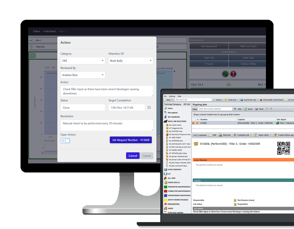



The right software can be a game changer for factory productivity and performance. With the appropriate tools, manufacturers can optimise operations through real-time monitoring, quality assurance, and intelligent decision-making. One such tool is a Manufacturing Execution System (MES). This type of software helps manage and optimise manufacturing processes with features that provide control and visibility across the shop floor.
In this article, we’ll explore what MES software is, what it does, its key benefits, and how Maintmaster OEE compares.
What does an Manufacturing Execution System (MES) Do?
A Manufacturing Execution System (MES) is designed to manage, monitor, and control production in real-time. It serves as the bridge between business systems (like ERP) and the factory floor, offering insight and control into the manufacturing lifecycle.
Core capabilities of MES software:
-
Real-time production visibility
-
Quality control and defect tracking
-
Performance analysis and continuous improvement
-
Production scheduling and planning
-
Resource allocation and utilisation
-
Inventory and materials management
By providing a centralised view of the production process, an MES improves operational management and supports smarter, faster decisions.
Key MES benefits for manufacturers
Increased production efficiency
MES software helps streamline operations by identifying inefficiencies and providing data-driven insights. With better process control, manufacturers can reduce costs and increase output.
Enhanced quality control
Real-time data ensures quality issues are detected and resolved quickly. This leads to fewer defects, reduced waste, and improved compliance.
Maximised uptime
An MES helps develop more realistic maintenance schedules and improve equipment utilisation, increasing overall uptime across the production line.
Better inventory management
Integrated inventory tracking ensures materials are managed efficiently, reducing overstocking and under stocking issues.
Paperless shop floor
Digitising the production environment removes the need for paperwork, enabling faster access to accurate information.
Improved traceability and compliance
MES software enhances traceability from raw materials to finished goods, simplifying audits and improving regulatory compliance.
MES vs ERP: What’s the difference?
While both Manufacturing Execution Systems (MES) and Enterprise Resource Planning (ERP) systems play essential roles in manufacturing success, they serve fundamentally different purposes within an organisation.
An MES is primarily focused on shop floor control. It operates in real time, providing live data directly from production lines. This includes insights into machine performance, quality tracking, defect identification, scheduling, and resource utilisation. Because MES software is typically integrated with machines and sensors on the factory floor, it enables immediate visibility into operations and allows for timely, informed decision-making.
In contrast, an ERP system is designed for business-level management. It works at a broader organisational level, handling planning, finance, human resources, customer relationship management (CRM), and reporting. ERP systems rely more on historical or periodic data, offering a summarised view of past activity rather than real-time performance metrics.
Another key distinction lies in integration. While MES systems connect directly with equipment and production systems, ERP software tends to integrate with other business tools and departments such as finance, HR, and sales.
Despite their differences, MES and ERP systems can be highly complementary. Many forward-thinking manufacturers choose to integrate both systems, creating a seamless link between factory floor operations and wider business processes. Maintmaster OEE, for example, is designed to integrate smoothly with ERP systems, offering a powerful combination of real-time operational control and strategic business planning.
By using MES and ERP together, manufacturers can gain a holistic view of performance, maximising productivity on the floor while ensuring alignment with business goals.
How Maintmaster OEE compares to MES
At MaintMaster, we consider Maintmaster OEE to be a smart, scalable alternative to traditional MES software. It provides many of the key MES functionalities in a leaner, more accessible package—ideal for manufacturers at any stage of their digital transformation.
Core functions of Maintmaster OEE:
-
Real-time data collection from machinery and operators
-
Scrap and rework loss reporting
-
Cost of Quality (CoQ) visibility
-
Custom quality checklists and compliance tools
-
Visual dashboards for trend analysis and actionable insights
ActNow alerts:
Proactive alerts notify users via SMS, email, or in-system popups when performance thresholds are breached, enabling swift action to maintain optimal OEE levels.
Seamless integration:
Maintmaster OEE integrates with ERP, APS, CMMS, and QMS systems—offering manufacturers a flexible and connected production ecosystem.
Scalable and configurable for every manufacturer
Whether you're managing one machine or scaling across multiple production lines, Maintmaster OEE grows with you. The platform is modular, allowing manufacturers to start small and expand functionality as required.
Our intuitive dashboards and automated data collection save time, reduce errors, and make it easier to identify inefficiencies. With options for both entry-level and advanced users, Maintmaster OEE supports your entire team in driving continuous improvement.
Is Maintmaster OEE right for you?
If you're looking for the power of an MES but don’t need a full-scale system, Maintmaster OEE is an ideal solution. With real-time insights, smart alerts, and proven ROI, it empowers your team to make informed decisions and achieve consistent manufacturing excellence.
Start your OEE journey today with Maintmaster OEE—gain visibility, improve performance, and stay competitive.