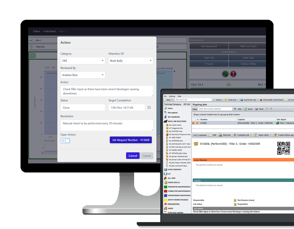
Reduction in corrective maintenance
Turn recurring losses into stronger investment cases
Stop building maintenance budgets on fragmented evidence. Maintmaster Manufacturing Intelligence helps you turn operator notes, comments and downtime data into structured issue categories, clearer cost exposure and better-supported business cases for upgrades, redesigns and targeted improvements.


Why teams use Maintmaster MI
Standardise recurring issues
Turn inconsistent operator shorthand and comments into structured issue categories you can analyse at scale.

Quantify cost exposure
Combine recurring issue patterns with OEE & CMMS data to estimate frequency, duration, and impact.

Prioritise investment by impact
Rank chronic issues by operational and commercial exposure so you can focus budget where it is most likely to pay back.

Without structured evidence, the biggest losses often stay underfunded.

Before
Difficulty securing budgets
Plant directors and maintenance leaders often struggle to secure budgets because requests rely on anecdotal evidence, inconsistent shift notes, and fragmented production data. As a result, capital is often directed towards the loudest complaints rather than the most financially significant losses.

Action
Standardise the issue. Quantify the exposure. Build the case.
Maintmaster MI helps you structure operator notes and combine them with downtime data to identify recurring issue patterns across lines, machines, and shifts. This gives leadership a clearer basis for investment decisions.

Result
Faster decisions. Better-targeted investment.
With clearer evidence behind recurring losses, leadership can prioritise upgrades, redesigns, and improvement initiatives with more confidence. Teams can focus on the issues creating the greatest operational and financial impact.
Powerful tools for stronger business cases

Pattern-based impact cost analysis
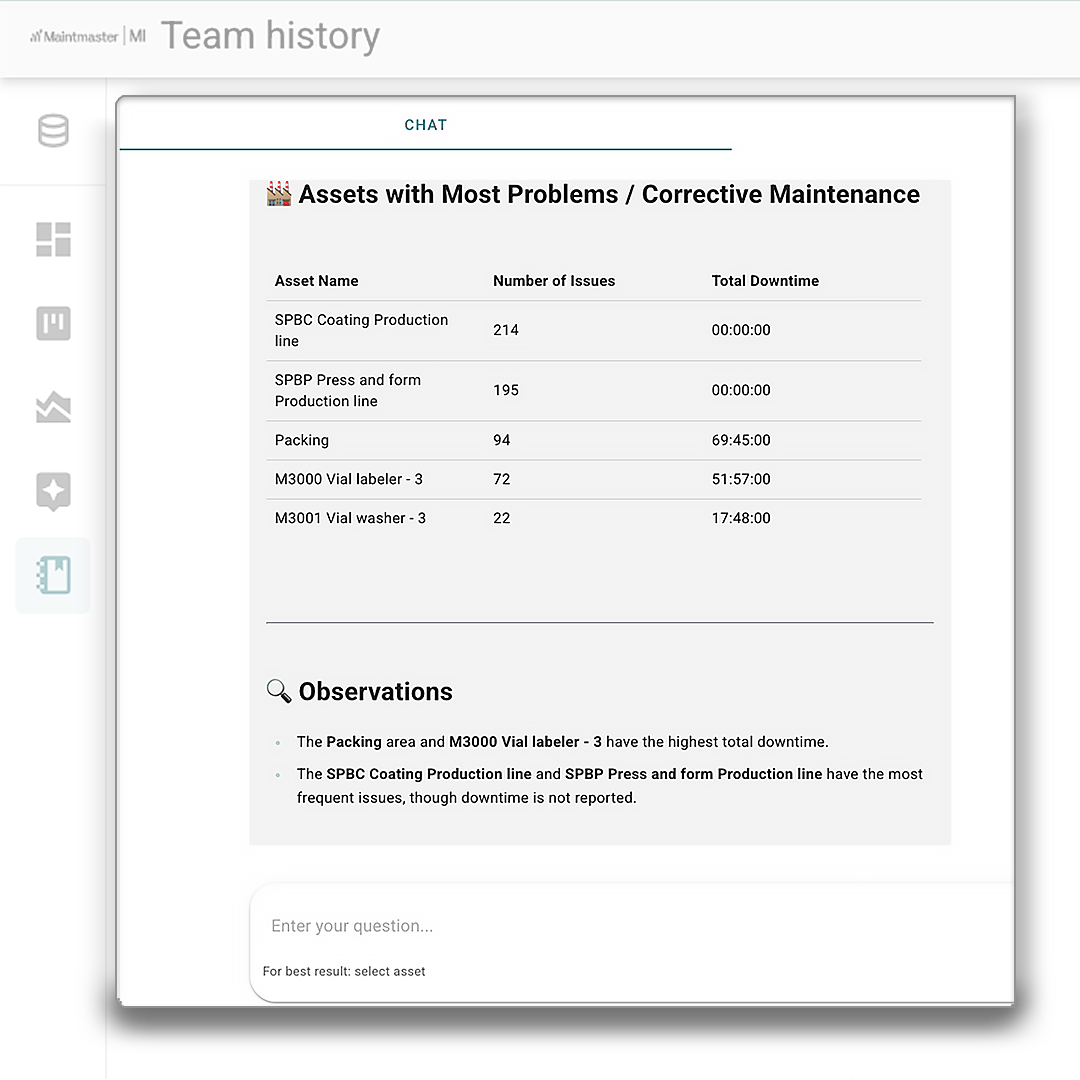
Turn downtime data into finance-ready decisions. MI reads operator shorthand and logs, tying recurring floor-level issues to actual downtime data so you know exactly what is bleeding profit.
Rank recurring losses by downtime cost exposure
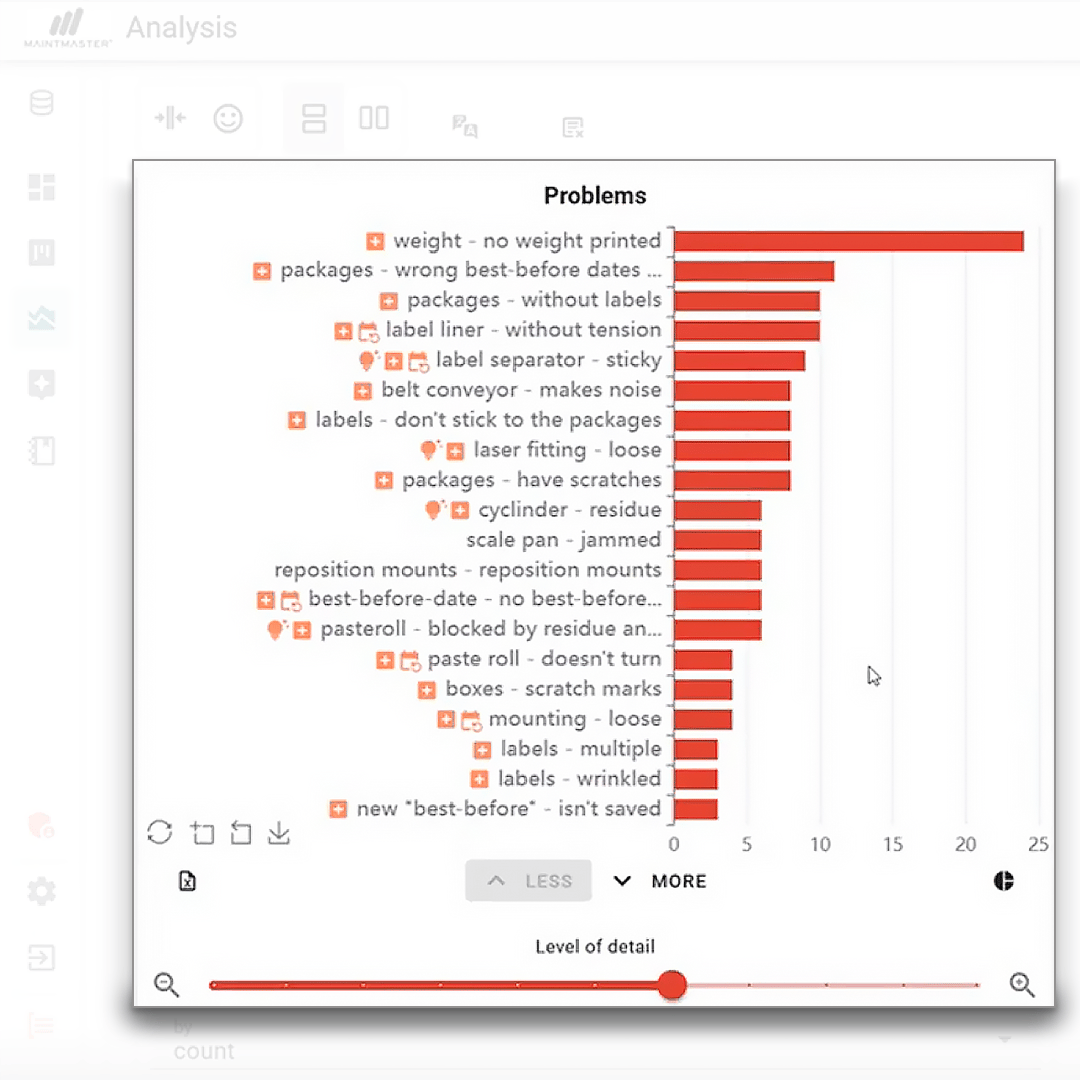
Turn repeat issues into measurable savings potential. View chronic losses in Pareto-style charts that combine OEE & CMMS data with structured operational context, helping you identify the highest-impact site-objects, understand where cost exposure is greatest, and focus investment where it matters most.
Build undeniable business cases
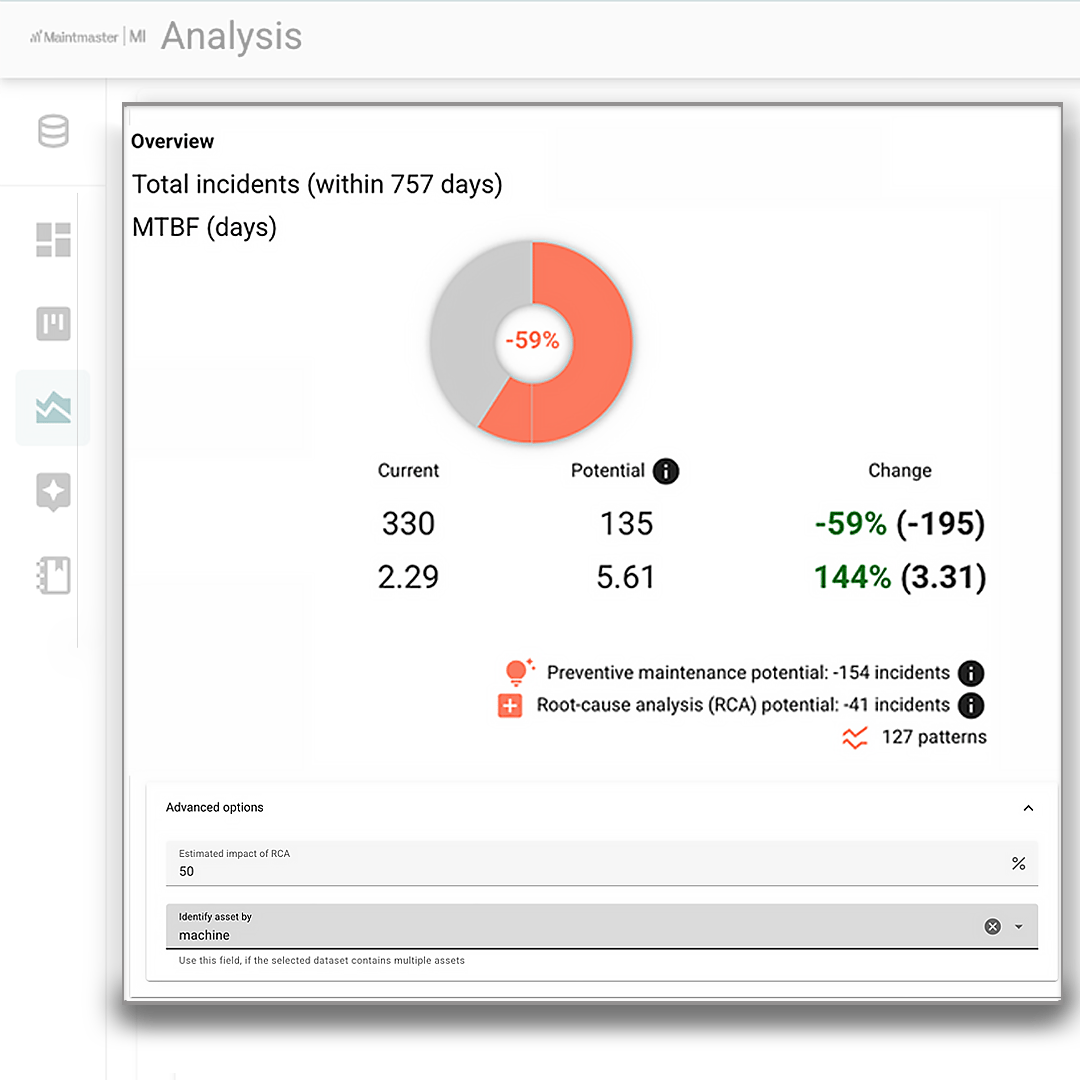
Turn downtime into a business case. Back upgrades and reliability work with hard downtime data. Export an impact report that makes the improvement opportunity visible in hours — and easy to value in pounds.
Proven results. Turning data into approved budgets.
Reduction in repeat chronic losses
faster to build a business case


Before and after
Maintmaster MI

The old way
Spreadsheets and fragmented evidence
- Hard to prove the ROI of maintenance investments
- True cost of recurring faults hidden in text notes
- Budget requests delayed by leadership pushback
- Capital spent on the loudest complaints

The new way
Smart, proactive, data-driven
- Clear financial linkage between downtime and cost
- Operator notes turned into quantifiable data
- Fast, data-backed approvals from the CFO
- Capital deployed strictly for maximum ROI
Turn shop floor data into bulletproof business cases with Maintmaster MI
Give your team the hard data needed to justify preventive upgrades and redesigns. Stop guessing your cost exposure and start building undeniable cases that secure budget fast.

See other MI use cases
Institutional knowledge capture
Never lose expert knowledge again. Turn decades of shop-floor experience into a searchable, plant-wide asset.

Decision support layer
Know where to focus next. Connect CMMS, OEE, and operational data to help teams identify where to act first.

Preventive Maintenance optimisation
Align your maintenance with reality. Stop over-maintaining healthy machines and missing the ones about to fail.
See other MI use cases
Data-driven improvement investments
Turn recurring losses into data-backed business cases.
Preventive maintenance optimisation
Align your maintenance with reality to cut unnecessary work.
Institutional knowledge capture
Never lose your best technician’s knowledge to retirement again.
Frequently asked questions
- What kind of data does MI use to build an investment case?
- MI draws on the data your teams are already generating — operator notes, work order comments, and downtime logs from your CMMS and OEE systems. It structures that raw, often inconsistent information into recurring issue categories, then combines it with actual downtime duration and frequency to give leadership a financially grounded picture of where losses are occurring.
- How does MI turn operator shorthand into something finance will take seriously?
- Most budget rejections happen because the evidence is anecdotal. MI standardises floor-level language — abbreviations, informal notes, shift-specific terms — into structured issue categories that can be quantified, ranked by cost exposure, and presented in a format that makes the financial case clear without requiring manual analysis.
- Can MI show which machines or lines are costing us the most?
- Yes. MI surfaces chronic losses in Pareto-style views that rank issues by downtime cost exposure across specific machines, lines, and shifts. This means investment conversations start from the highest-impact assets rather than the ones that happen to have the most vocal advocates.
- How long does it take to produce an impact report?
- MI can generate an exportable impact report in hours rather than weeks. Because the underlying data is already structured and linked to downtime costs, there's no need to manually compile evidence from multiple systems before you can make a case to leadership or a CFO.
- What if our recurring losses are spread across multiple sites?
- MI is designed to identify patterns across lines, machines, and shifts — including where the same issue is recurring in different locations under different names. That cross-site view is often where the biggest underfunded losses are hiding, and it's exactly the kind of evidence that justifies coordinated investment rather than site-by-site firefighting.