


You are told that AI holds the answer to your manufacturing bottlenecks. But when your basic troubleshooting data is missing, scattered, or undocumented, your plant operations are held hostage by the unknown. Hard-won engineering insight evaporates the moment a shift ends. Every undocumented fix creates a data blackout, and no AI tool will rescue you from bad data.
In this article, you will learn how to bypass the AI hype and use the raw maintenance data you already have to start turning a real profit.
Hoarded knowledge and the daily data blackout
The shop floor suffers from a systemic blackout of usable data. Unlike the highly structured tracking of the core manufacturing process, maintenance personnel do not document their work the same way production does. Because factories have a fundamental problem with not having information, workers are often left empty-handed when a site object goes dark.
You likely do not have a blank maintenance history. Instead, you have thousands of unstructured work orders. When you cannot access that information quickly, it directly translates to extended downtime and paralysed response teams. Buried historical context turns every mechanical failure into a hunt through scattered notes.
When a site object fails, maintenance personnel are forced to find data on the fly. Today, your critical knowledge is scattered across personal memory, outdated schemas, PDFs on a shared drive, and fragmented maintenance logs. A few experienced people might know the equipment by heart, but relying on them does not scale.
Building a unified view that is instantly available the second a breakdown happens is hard. Nobody wants to tear into a jammed site object only to end up with 3 variants where they do not really know which one applies. Guesswork in the middle of an active shutdown drains profitability by the minute.
The demand for verified intelligence never stops. Plant personnel need exact instructions to maintain operational tempo, whether the line is humming smoothly or completely down. Whether your operators are looking for what to do in the next step so they can start as quickly as possible, or facing a stop where they need the information here and now, the requirement is the same.
Accessible data is the invisible lifeblood that either sustains industrial momentum or forces a dead halt. Solving this data drought is the only way to pull the operation back from the brink.
False fixes built on gut instincts and software miracles
The same unstructured data that complicates troubleshooting also paralyses your proactive improvement work. You cannot build an improvement strategy without a reliable database to rank your operational priorities. Without hard facts, leadership reverts to gut feelings.
This turns capital allocation into a subjective popularity contest. Managers base decisions on vague impressions because you do not have the proof points to back them up. The result is a culture that rewards whoever shouts the loudest to get their projects done.
Sometimes you invest in dedicated continuous improvement managers to fix this. However, these roles are almost always tied strictly to the production department. Most operational problems cross departmental lines. This means production constantly pushes other teams for change, even though improvement should be a joint effort.
To validate ideas and prioritise projects, these continuous improvement managers must read through old work order logs manually. You often end up hiring interns or data analysts just to process the data for hours on end. They try to categorise information by hand, turning skilled problem-solvers into full-time data entry clerks.
To escape this manual grind, you might look for a technological silver bullet. But industrial AI is rarely the magic trick you expect. You might have ignored early software solutions because you demanded impossible revelations instead of practical clarity. You hesitated to buy in because you thought some miracle AI was going to happen, expecting algorithms to uncover mysterious problems you had never seen before.
The practical truth is that your top 5 site objects causing losses should never be a surprise. Demanding that software acts as a crystal ball blinds leadership to the real value of organising the chaos you already know exists. When these unrealistic expectations collapse, your personnel fall back on exhausting manual habits.
Siloed databases also create conflicting realities on the shop floor. Legacy structures force your maintenance and operations teams into opposing camps, making it impossible to agree on why a site object actually failed.
Because older systems required rigid, unintuitive setups, you often find that the Pareto chart from your OEE system and the Pareto chart from your CMMS do not line up. The operational software tells you 1 thing is your biggest outage, while the maintenance system blames a different cause. Crews simply do not know which work order belongs to which downtime event. A factory running 2 conflicting versions of the truth cannot permanently solve its root problems.
Breaking this loop of misdirection requires a fundamentally different approach to unifying the operation. That unified reality cannot be built on boardroom assumptions. Improving plant availability needs hard numbers.
Lost capacity through isolated silos and invisible losses
When maintenance and engineering leaders attempt to modernise a site object, they run headfirst into a budgeting war. If a team decides they need a new labeller, they cannot rely on the impression that you have 5 maintenance personnel and 20 production personnel.
They must justify the exact expense and do the internal selling to sceptical production and plant managers just to get the initiative off the ground. Without undeniable data showing the top loss reasons and tracking exactly where time is wasted, high-value improvements die in committee. This boardroom paralysis does more than kill capital projects. It actively undermines collaboration across the facility.
Production and maintenance are trapped in isolated silos. Frontline personnel see the exact mechanisms of failure every day, yet they lack the cross-functional authority to put a real fix in place. Operations teams frequently pull data from the OEE system and isolate the root cause of a failure, only to find the project stalled because maintenance would not be part of it. When critical departments refuse to share ownership of an equipment problem, a factory is forced to apply temporary fixes to long-running issues.
This high-level structural friction trickles down to the shop floor and turns routine procedures into guessing games. Operators are flying blind during routine execution. Without access to a shared history of equipment modifications, technicians are forced to guess on outdated instructions.
A worker trying to swap a label roll might follow the manual perfectly, unaware that a colleague previously adjusted a measurement, going up and down to find the best result. Because someone built an improvement on the site object that makes the basic manual incorrect, the operator is inadvertently setting the site object up to fail. Undocumented physical tweaks turn standard operating procedures into traps, guaranteeing that the same mistakes are repeated across different shifts.
These isolated instances of miscommunication compound quickly, creating predictable craters in daily production targets. Recurring operational losses hide in plain sight. Factories lose capacity during routine transitions because institutional memory evaporates the moment workers clock out.
Your OEE data might show the line is consistently running at half speed for the 1st hour after a shift change, directly resulting from the reality that some form of communication is lost during the handover. Proper analysis separates the random, 1-time glitches from the chronic, repeating failures, dictating exactly when engineering must step in to physically design the fault out. Capturing these invisible losses from the noise is the only way to move past reactive habits and force a permanent shift in strategy.
The financial cost of disconnected reporting systems
When departments bring conflicting numbers to the table, the resulting turf wars destroy any chance of securing budget for critical upgrades. Because a disjointed Pareto chart causes friction, teams lose continuous improvement opportunities in that specific area of internal selling.
Aligning the data takes the emotion out of capital requests. There is no fight between the 2 departments, and the facility can act as a unified front. But even with aligned data, executing those improvements needs time that floor leaders simply do not have.
Even when leadership expects continuous optimisation, proactive improvement is a luxury your maintenance managers cannot afford. The grind of keeping broken site objects running consumes every available hour. The reality is your team does not have time to do Manufacturing Intelligence (MI) because of how your data is stored.
Because your historical records are buried and unstructured, finding a single actionable insight needs hours of manual digging. Your maintenance managers are too involved in the daily immediate corrective maintenance cycle to manually cross-reference downtime logs. As a result, meaningful continuous improvement falls off the schedule. When data is this hard to extract, optimisation becomes an optional side task, and your factory stays in a reactive loop.
To break this cycle, you often throw manual labour at the data problem, creating a new set of vulnerabilities. Relying on manual data processing is a fragile, expensive bet. Throwing analysts at mountains of logs inflates the payroll while tying the speed of business decisions to the physical well-being of a few isolated individuals.
Working through this data is a very expensive fixed cost for large operations, and the logistical risks are high. If an analyst goes to the toilet, you have lost something. If they are sick again, it takes 4 days just to get a basic report. As a result, you simply do not have the right information at the right time for your decision later, leaving leadership without insight at the exact moment they need to pivot.
This lag in intelligence directly hurts the factory's primary objective: keeping the lines running and pushing products out the door. Every second of unresolved downtime is a direct, unrecoverable hit to the bottom line. Modern supply chains are unforgiving, and failing to maintain pace immediately disrupts downstream customers who depend on a flawless rhythm. Operations leaders do not have time to not produce, and absolutely cannot afford more errors in your just-in-time flow because you might be the 1 delivering to the next step.
If you can optimise your internal pressure so that the flow through your factory gets better, however small or large it is, you would earn more from it. Throughput dictates profitability. Unblocking bottlenecks through better intelligence is the fastest path to expanding margins. Yet pushing for higher speeds without rigorously capturing the physical changes on the floor introduces the most serious risk of all.
Unifying operations and maintenance to fix floor friction
True operational visibility needs equipment performance to be connected directly with maintenance records. When systems live in isolation, facilities waste time arguing over which data to trust instead of fixing the actual problem.
Maintmaster Manufacturing Intelligence (MI) closes this gap by making sure the outages from Maintmaster OEE and the work orders from Maintmaster CMMS are directly connected. The software links the databases so we know exactly which item belongs to which, proving that a logged failure and a maintenance work order are actually the same downtime.
Removing the boundary between operations and maintenance generates 1 unified Pareto chart that serves as a single source of truth. Once the departments finally agree on what broke, they can immediately focus on precisely when and why the system failed.
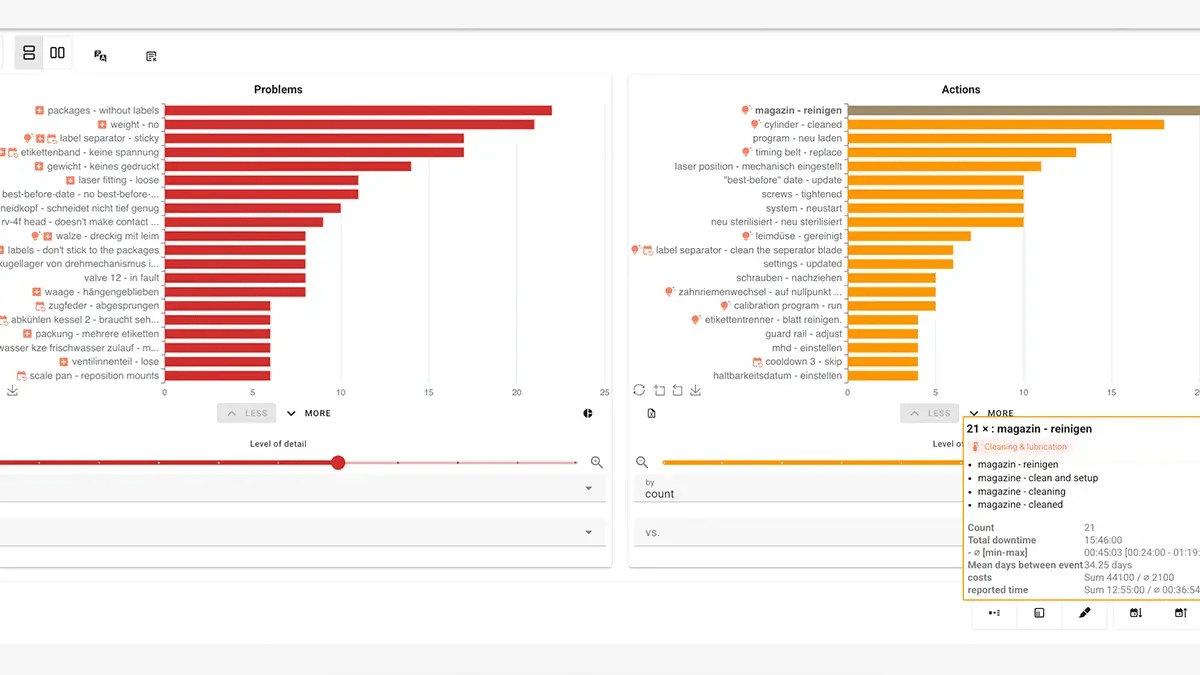
Time is the ultimate metric for diagnosing equipment failure. Broad averages hide the reality of factory performance, masking the drops in productivity that destroy profit margins. The unified timeline shows the exact moments a line crashes.
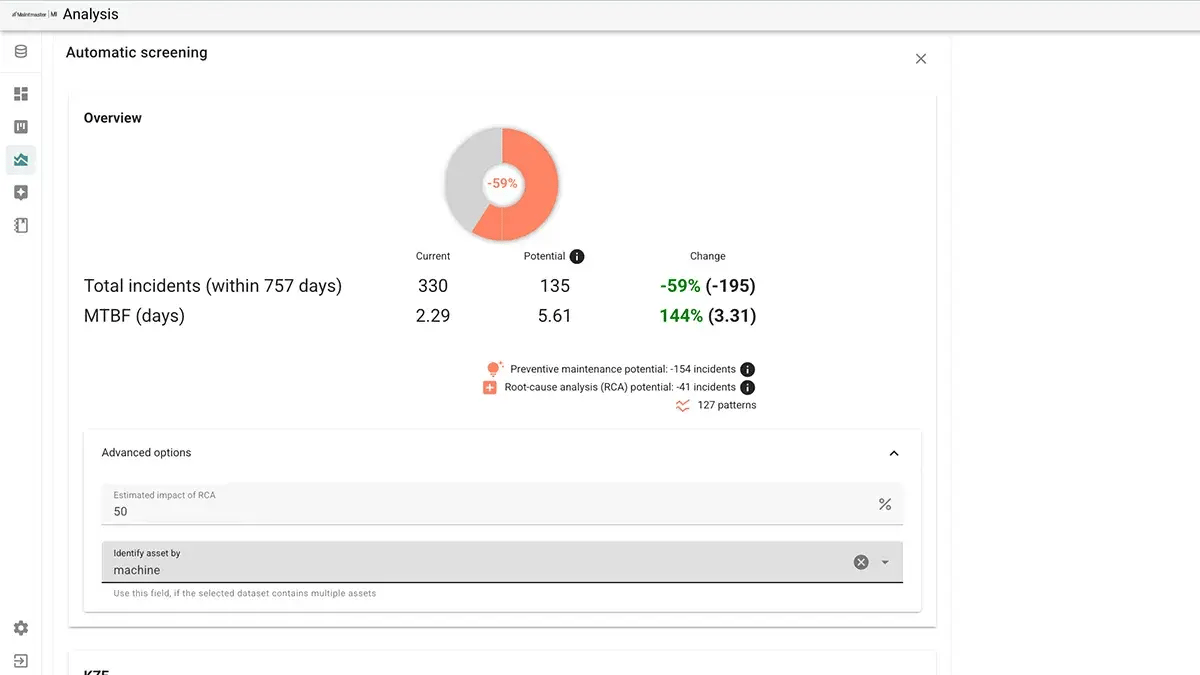
If a factory tracks an 85% goal, as soon as it becomes 83% or 33%, the software flags the loss. When production suddenly hits the dips, when it is not 85% but 45%, operators can pinpoint the exact time and date of the failure. Showing patterns where certain things occur at a certain frequency, at certain times provides the concrete foundation needed for designing the fault out of the manufacturing process entirely.
Identifying these failure patterns is only valuable if the intelligence reaches the right hands before the line stalls again. Digital automation beats manual human analysis in both speed and stamina. Waiting days for an analyst to manually pull logs and build a report means the data is already out of date by the time leadership sees it.
MI deploys a tool that reads through everything directly, navigating different levels in hierarchies so operators do not have to look themselves or even click their way forward. The computer does it for them, 24 hours a day. Users get answers instantly, and Maintmaster makes you reach the information 10 times faster.
Removing the human bottleneck means the answer is just 1 button press away all the time. Faster access to past failures naturally evolves into systems that can predict and intercept the next breakdown.
Modern manufacturing software must anticipate problems. Overworked managers lack the bandwidth to dig through analytics just to figure out their next strategic move. MI solves this by generating proactive recommendations tailored to specific roles.
For maintenance managers who do not have the time to understand these complex things, a chatbot lets them simply ask what they should do to reduce downtime on the labeller, and the chatbot will tell them. Continuous improvement managers can use the chat to query the system before being linked back to the standard interface for deep-dive execution. Tailoring the intelligence to the specific constraints of the user makes sure that both executive oversight and frontline engineering act on the same proactive insights.
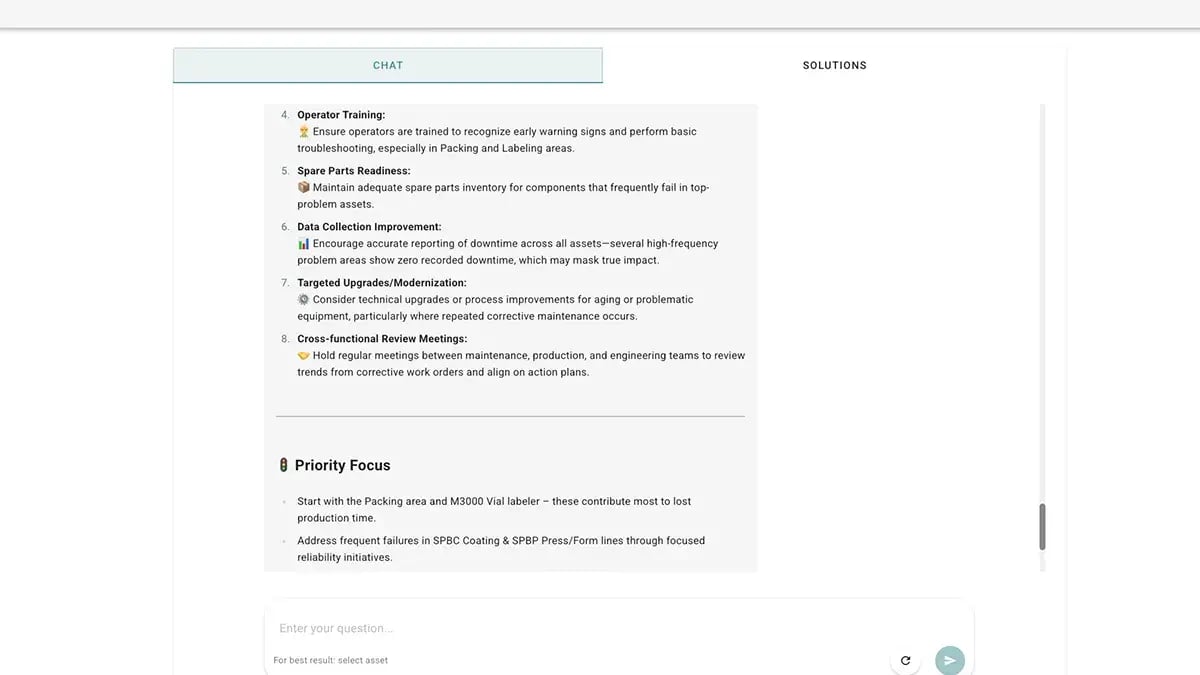
Embedding these automated advisors directly into the daily workflow makes optimisation a habit. Intelligence tools only work if they live exactly where the actual work happens. Forcing mechanics and engineers to toggle between separate analytical platforms guarantees those tools will be ignored during a crisis.
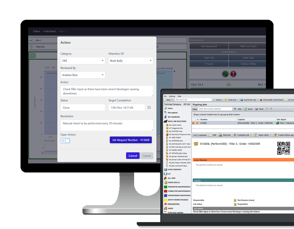
Maintmaster CMMS puts icons right there on the screen that launch MI instantly, bridging the gap between logging a work order and analysing the root cause. The architecture is evolving to include a dedicated MI bot or agent alongside the standard KPI panel, so users always have a tip at the top, which is a recommendation on what they should do.
Keeping the chat open all the time turns the maintenance software from a passive ledger into an active partner that continuously offers preventive maintenance tips for a specific site object. By combining operational data with automated guidance, facilities finally turn their chaotic history into a clear blueprint for the future.
Scaling proof and replacing reactive maintenance habits
Scaling operations forces a shift toward data-driven decisions. The transition is rarely clean. Facilities inevitably start with chaotic, disorganised records that make executives sceptical of new investments.
When a plant scales to at least 10 maintenance managers, they typically hit a mixed data quality situation. Yet teams can still grab the 1st low-hanging fruits that you can get out of the messy, not-so-good documentation. Extracting basic wins from bad data validates the entire software rollout to hesitant leadership. Once floor workers see 1 or 2 examples of their fragmented notes actually fixing problems, they are convinced to permanently upgrade how they log their data.
Visualising failure patterns immediately reduces immediate corrective maintenance. Traditional platforms trap this intelligence in rigid silos, making it difficult to pull accurate reports across different locations.
MI delivers multi-site dashboarding relatively easily, a task that is really hard in a standard CMMS to get selections right. Customers are often happy just to get the dashboard, because observing the number of issues from immediate corrective maintenance work orders clearly shows the drop in immediate corrective work. Giving leadership a unified view across multiple plants turns isolated facility data into a coordinated corporate asset.
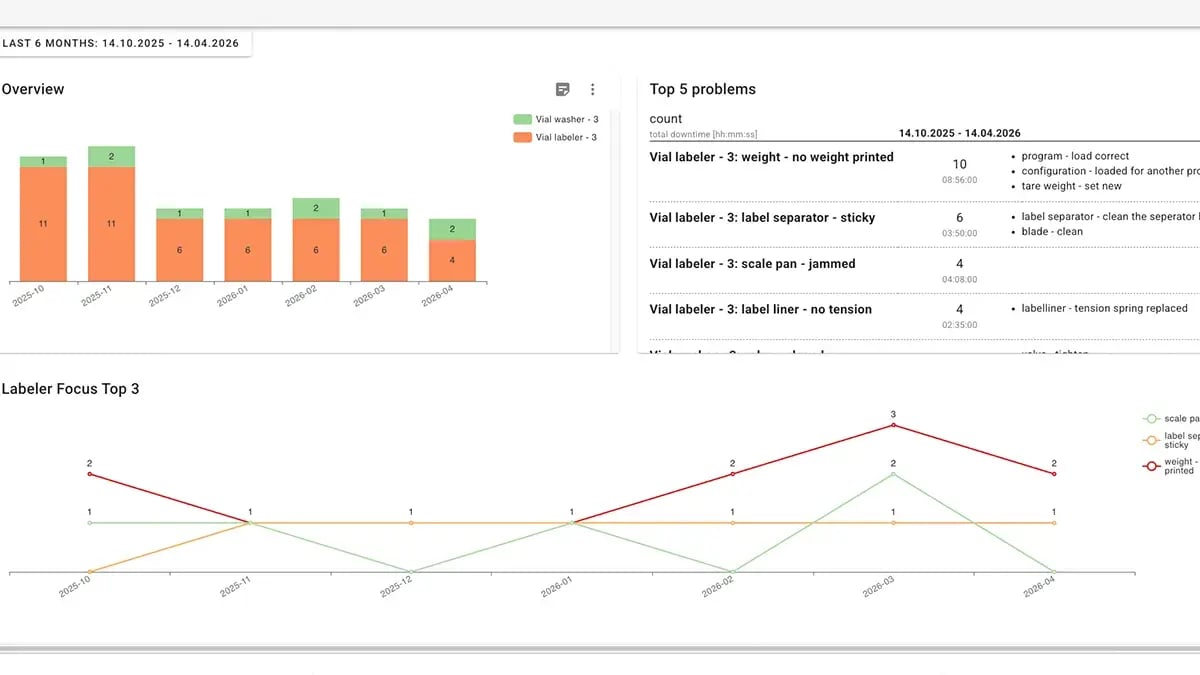
Moving from passive observation to active, company-wide intervention needs total execution alignment. Real operational gains need full organisational buy-in. Without complete confidence in the system's accuracy, operators will second-guess the instructions and revert to old, error-prone analogue habits.
The manufacturer Clearly Drinks proved this by securing the buy-in of everybody. They ran the system for about half a year, started doing projects based on it, and got real improvements out of it. Acting on this data is as foolproof as using a mobile payment app where you scan a QR code and then you know it is right, rather than standing and typing in the number and hoping the numbers are right. When the software guarantees precision, execution on the factory floor becomes automatic.
This elimination of guesswork unlocks an entirely new pace of problem-solving. Instant data retrieval directly multiplies physical production speed. Every second workers spend hunting for lost documentation keeps the line dead and loses revenue. Depending on how you structure the setup, users often realise that it is 10 or maybe even 20 times faster to find critical documents with Maintmaster.
This speed resonates perfectly when you talk to the operator about time and money, because if they worked on piece-rate, they would gladly embrace the system so they could go home after 6 hours. Time saved on the floor creates a more even flow that improves the company's margins while improving the daily grind for the mechanics.
Putting physical reality ahead of AI hype
For years, you might have fallen into the trap of expecting magical software solutions, defaulting to a culture where whoever shouts the loudest gets their projects done. We must actively dismantle these expectations, directly telling buyers that the technology is not going to surprise you because a plant's top 5 site objects causing losses should never be a surprise.
Forcing leaders to admit they already know their worst site objects shatters the illusion that some "miracle AI" is going to happen. Stripping away this digital buzzword forces a cultural pivot in how a factory uses its own history.
The real competitive edge lies in the raw, ignored knowledge already sitting on the shop floor. Mechanics have spent decades logging failures, but extracting actual tactical lessons from that mountain of text has historically been a major failure point. To bypass the hype, modern deployment completely drops the AI pitch and focuses entirely on making use of the notes that you already have.
Acknowledging that you write down notes in order to learn from them, which has always been hard, validates the daily grind of the maintenance crew while offering a concrete lifeline. Grounding the solution in the gritty reality that the site object is on the floor, not in the office, turns abstract analytics into a physical advantage. Unlocking those physical floor notes builds compounding momentum across the entire production line.
Automating data analysis triggers a continuous cycle of profitability. Manual processing artificially caps a factory's output, creating a rigid bottleneck where slow human interpretation chokes industrial throughput. In any high-volume environment, unlike slow handcrafts where the value is appreciated in how well it is done, production acts like a river. Speed dictates that more water simply comes downstream in the end.
Removing the human from this analytical bottleneck means operational gains stack percentage on percentage. The time saved compounds on a percentage of your profit. By stepping out of the way and letting the system process the friction, you permanently replace manual guesswork with a continuous, self-improving engine.