


Advanex Europe manufactures high precision metal components for aerospace and medical devices across three sites: two in the UK around Nottingham and one in the Czech Republic.
The sites produce millions of parts each week. For the maintenance team, that means keeping high-volume production equipment running while maintaining the control needed in an audit-heavy manufacturing environment.
When one stopped machine can affect ten more
Some machines play a critical role in the production flow. Thomas Matthews, Maintenance and Control Systems Lead at Advanex Europe, describes them as bottlenecks. These machines feed other machines later in the process. If one rolling plant stops, up to ten downstream machines can be affected.
That makes maintenance control business-critical.
In this environment, it is not enough to fix the machine. The team also needs to know what happened, who acted, what was reviewed and whether the same issue is appearing elsewhere.
When maintenance records outgrow Excel
Before Maintmaster CMMS, Advanex managed maintenance through a mix of Excel sheets, databases and paper records. Corrective maintenance was tracked in spreadsheets. Preventive maintenance was recorded on paper and stored in binders. Calibration was managed by another team in a separate spreadsheet. For a while, that way of working was manageable. But as the amount of information grew, it became harder to keep one clear view of maintenance activity.
Information sat in different places, and each process depended on people knowing where to look, what to update and who needed the information next. That made it harder to see what had been raised, what had been completed, what had been reviewed and what needed attention. In an audit-heavy manufacturing environment, Advanex needed maintenance records that were easier to control, review and present with confidence.
And so auditability became another major reason for change...
“The amount of time and preparation required to actually sit into an audit was multiplied by the amount of work you had to do,” says Thomas. “Having it all in one place means that we don’t have to do that preparation work anymore. We just turn up with our system and say, what would you like to see?"
Excel had become a central place for maintenance information, but Advanex needed a clearer way to raise, track, review and manage work across the business. Only team leaders had access to the corrective maintenance spreadsheet. If someone on the shop floor found an issue, they had to report it to a team leader, who then had to find the right spreadsheet and enter the job. That created extra steps and meant smaller issues were not always as visible as they could be. Calibration had a similar challenge. It was managed through another spreadsheet, with enough data that it could take around eight minutes to open. During the move into Maintmaster CMMS, duplicate assets were also found.
For Thomas, this showed the problem with using Excel beyond a certain point. It can work for a period of time, but once the volume of information grows, it becomes harder to manage. Advanex needed more than a place to store maintenance records. They needed a way to control the work from request to review.
Faster maintenance reporting from the shop floor
Advanex started with corrective maintenance because it was the area where the business expected the biggest immediate benefit. The first goal was clear: remove the corrective maintenance spreadsheet and give people across the business a simpler way to report issues. Maintmaster CMMS made that possible through QR codes.
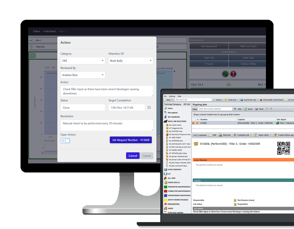
Operators can now use a phone or tablet, scan the QR code on an asset and raise an issue directly against the correct machine. The asset is already identified. The reporter’s name is captured. The maintenance team can see where the issue came from and who to speak to if they need more detail. That changed the quality of incoming work. It also changed the speed.
Instead of reporting to a team leader who then has to find a spreadsheet buried in a Teams folder, people can report directly from the shop floor. “They open up the app on either the phone or tablet, take a snap of the QR code and they’re immediately into reporting an issue,” says Thomas.
QR codes did more than make reporting easier. They changed what the business could see.
Before Maintmaster CMMS, small jobs were often not logged. Maintenance engineers were busy, but the full workload was not always visible. That made it harder for senior management to understand how much work the maintenance team was carrying.
With Maintmaster CMMS, more work is captured. Issues are now more commonly reported, no matter how big or small. “The question used to be, what is the maintenance team actually doing?” says Thomas. “Now that Maintmaster is there and logging everything, it’s quite simply not the case.”
The work was always there. Maintmaster CMMS made it visible.
A clearer path from work request to review
For Advanex, one of the clearest changes is the corrective maintenance workflow. A work order is raised in Maintmaster CMMS. If it is corrective maintenance, it goes to the engineering team on the shop floor. If it is a task suggestion, Thomas reviews it first and decides whether it should go ahead. That review step helps the team separate actionable maintenance work from requests that need more detail or context, so the engineers can stay focused on the jobs that need their attention first.
Once a job is accepted, it is prioritised. The team works through the list based on what needs attention first. Some jobs are completed in one visit. Others take several visits, especially when parts are needed. Once the job is marked as done, Thomas reviews it before it is completed and archived, creating a clear audit trail from request to action to review. That gives Advanex a controlled maintenance flow.
Before Maintmaster CMMS, the same process was managed through Excel. A short description was entered, and engineers added updates as the job progressed. That worked for a period of time, but Excel gave the team fewer built-in ways to separate each stage of the job. As work moved forward, earlier context could become harder to review.
With Maintmaster CMMS, Advanex has a clearer workflow for each job. The team can see who raised the work, who completed it and who reviewed it before closure, giving maintenance records a more structured path from request to action to review.
Bringing maintenance, calibration and safety together
Once corrective maintenance was live, Advanex moved preventive maintenance into Maintmaster CMMS. This brought paper-based records into the same system as corrective work. The rollout started at Southwell. Corrective maintenance went live first, followed by preventive maintenance soon after. Once the team was happy with the setup, Advanex rolled the system out to the Bilborough site and later to the Czech site.
Calibration became the next step.
For Advanex, calibration is closely linked to quality and audit control. The quality team needs to know when equipment is due for calibration, who needs to act and whether anything is at risk of going out of date.
Before Maintmaster CMMS, calibration was managed in yet another spreadsheet. That created familiar problems: manual updates, duplicate records, slow access and reliance on people checking due dates. Thomas compares calibration labels to an MOT sticker. The date may be there, but the business cannot rely on people noticing it at the right time.
With Maintmaster CMMS, calibration activity is controlled in the same environment as maintenance work. The quality team can track when calibrations are due, emails go to the right people, and equipment can be collected and sent for calibration before dates become urgent. That helps Advanex stay ahead of calibration work without relying on manual checks or last-minute follow-up.
Advanex also uses Maintmaster CMMS to connect health and safety follow-up with maintenance work.
Previously, safety records were managed in a separate system. When a safety observation required maintenance input, the follow-up work had to be raised and tracked separately by the maintenance team. Advanex changed the process by creating a dedicated safety workflow in Maintmaster CMMS. Safety-related maintenance actions can now be raised, assigned, tracked and completed in the same system as other maintenance work.
That means follow-up actions are not managed as a separate side process. They sit in the same maintenance workflow as corrective and preventive work, with clearer ownership, visibility and completion tracking.
“The big thing is having it all in one place,” says Thomas. “If everything’s in one place, we know the audit trail is going to be clean.”
Maintenance reporting that helps teams prioritise
Maintmaster CMMS is now part of Advanex’s weekly reporting rhythm.
Every Monday, Thomas reports on the previous week’s maintenance activity and the forward plan. Summary boards give him a clear view of machinery uptime, breakdown contributors, open corrective maintenance jobs, preventive maintenance progress and upcoming contractor work. The same system also supports a Thursday maintenance team meeting, where the team reviews the current week’s work and what is planned for the following week.
That gives Advanex one place to see what has been completed, what is still open and what needs attention next. The business can see open corrective maintenance jobs. It can see whether preventive maintenance is on track. It can see upcoming contractor work and plan with production when access to a machine or building is needed.
For a small maintenance team, that visibility matters. Each site has three maintenance team members, including the controls engineer. When the workload is high, the team needs a clear view of what should happen first. Maintmaster CMMS helps Advanex manage that. Maintenance and production can discuss priorities with the same information in front of them, rather than relying on separate updates or assumptions.
“It’s easier for us to talk to production about what priorities are,” says Thomas.
Finding recurring asset failures before they spread
Advanex is also using Maintmaster CMMS to identify recurring asset issues. Filtering helps Thomas look across similar machines and find patterns in corrective maintenance. That has already helped highlight repeat work involving drive belts, bolts and bearings. In one example, Advanex found that the same drive belt was being replaced more often than expected across a fleet of 15 machines.
That gave the team a clear reason to investigate further.
The cause may be a design issue. It may be a material issue. It may be an alignment issue. The important point is that the team can now show there is a pattern worth investigating.
“We can say definitively there is a pattern,” says Thomas. This is where maintenance data becomes more than a record of completed work. It becomes evidence the engineering team can use to understand where further investigation is needed. Root cause codes also support this work. When jobs are completed, Advanex can review historical data to understand what is driving repeat maintenance activity across similar assets.
Why Maintmaster CMMS works for Advanex
When Advanex reviewed CMMS options, three things mattered: usability, auditability and the ability to configure workflows around the business.
The team did not want to force the business into a fixed process. They wanted a system that could support the way Advanex needed to work.
Maintmaster CMMS gave Advanex that flexibility. QR codes made it easier for people to raise jobs from the shop floor. Configurable workflows made it possible to manage corrective maintenance, preventive maintenance, calibration and health and safety in the same system. Summary boards gave managers a clearer way to review activity and plan what needed attention next.
“Even though it is a maintenance tool, it is a workflow tool,” says Thomas. “You can still use it for other things.”
Maintenance control Advanex can see and prove
For Advanex, Maintmaster CMMS has become more than a place to log maintenance jobs. It gives engineers a clearer list of what needs attention. It gives managers a review point before work is closed. It gives the wider business a simpler way to report issues from the shop floor. And it gives auditors a cleaner trail.
It also gives Advanex a better way to learn from maintenance data. Recurring issues are easier to find. Patterns across similar machines are easier to investigate. Maintenance workload is easier to explain. Priorities are easier to agree with production.
Going back to the old way would be difficult. Thomas says it would be unmanageable for one person to control the Excel sheets again. Work could be missed, data could become harder to maintain, and production would feel the effect.
“Having Maintmaster as a system is more than just a tool,” says Thomas. “It’s the way we have adapted to being able to control maintenance and make sure that it is being done correctly and in a timely manner.”
That is the value of audit-ready maintenance control. Not just proving what has happened, but knowing what needs to happen next.
/advanex_europe_ltd_logo.jpeg?width=200&height=200&name=advanex_europe_ltd_logo.jpeg)