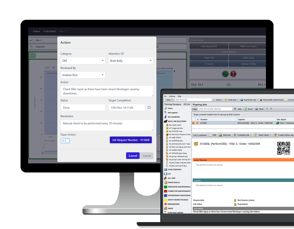



OEE gave the numbers and analysed reasons for production efficiency deficits. But what has that to do with preventive maintenance and CMMS, and vice versa? Read the article to learn why you should get both from the same supplier.
Plenty of manufacturers run a good CMMS and never touch OEE. Some run OEE and never touch a CMMS. Both groups do real work and get real results. If you're running CMMS well today, nothing here is a case against that.
What I want to show you instead is narrower: six concrete things I've watched OEE add to a maintenance team that already had good habits. Even though the two systems wouldn’t be technically bundled, having the data from both helps your people understand both maintenance and production better. Not just their own corner of it all.
1. Your preventive maintenance (PM) schedule can flex instead of just running on habit
A lot of preventive maintenance intervals were set years ago and never revisited. Ask why a machine gets a full overhaul every 500 hours, and the honest answer is often that somebody decided that a long time ago, and it stuck.
CMMS runs the schedule reliably, but OEE adds a reason to change the number. Feed in how the equipment is actually performing, and you can see whether 500 hours is still the right call, or whether it could safely be 800.
I've seen a plant where operations believed a certain machine needed resetting once or twice a week. Nobody had logged it as a problem, because it never felt like one, it was more of a habit. The OEE data put a price on it: those resets were costing around 10 minutes of production every single day.
Extend the interval based on actual machine performance data, and you're handing production extra running time on that machine, and handing maintenance extra time they're not spending worrying about it. Some plants go further and drop the fixed interval altogether, monitoring condition instead and stepping in only when the data says so.
2. Chronic line downtime stops being a mystery
A line that's chronically down for reasons nobody can quite explain, or a brand-new line still finding its feet? That's exactly where I want a screen telling me what happened, but also what caused it. The reason might be equipment, but it could also be something else.
Without OEE, that “something else” gets logged as "downtime, cause unknown”, shift after shift, for months.
With OEE, instead, diagnosis and fixes become faster. The maintenance team doesn't need to firefight something they have nothing to do with.
That matters most on a new line, before anyone's built up years of gut feel for what's normal. And once the pattern's on screen, funding the fix is easy to justify. Nobody argues with a chart that's been building for 3 months.
3. Speed loss you'd never spot on the floor becomes obvious
Downtime is easy to see, but speed loss is another story. If a line is built to run 100 units a minute but it actually runs 90, the floor might view it as a completely normal shift. That’s a 10% loss nobody clocked.
I've watched this happen more times than I can count: nobody realises the capacity is missing until OEE says so. Only then do people start asking why. Walk the line to investigate, and the cause is usually mechanical, not anyone's fault on the floor. A motor running hot. A worn conveyor bearing.
That's where CMMS earns its keep again: turning “why is this line slow” into a scheduled fix, tracked start to finish.
4. Capital requests get easier to justify, and easier to win
When a plant needs more capacity, the first instinct is to buy more equipment. OEE data makes the case for looking to use more the capacity you aleady heave.
Even a robot upgrade could wait for another year, if you’re tight on investment funds. The business case could be, for example, a 0.5% OEE improvement, worth around $5 million a year, against a $450,000 upgrade.
OEE gives the number. Turning that number into a funded, scheduled, resourced project on a specific asset is where CMMS and a maintenance team's judgement takes over. Teamwork at its best, isn’t it?
Read more from CooperVision: "We had run out of space to install new platforms. We had to think differently."
5. Inconsistent shift performance reveals need for employee training
I've seen a line where one shift consistently underperformed the other three, and it had nothing to do with the equipment itself. One operator had a personal feel for the “right” settings and quietly adjusted them every time that shift came on.
OEE made the pattern visible across shifts. When there’s a visible correlation between certain settings and overall efficiency, there’s no room to argue who has the better gut feeling. This time, the fix was to teach the operators a simple rule: look at how the line performed on the previous shift, and if it performed well, don't touch the settings.
And thanks to that data, the maintenance team recognised it wasn't a mechanical problem at all, so nobody wasted time stripping down a machine that wasn't broken.
6. Spare parts stock gets right-sized, not stockpiled “just in case”
CMMS knows what parts actually get consumed. OEE knows which equipment is the most critical for your production efficiency and how often it fails.
Look at consumption against criticality, and the picture rarely matches what the stockroom assumed, did it? Some expensive parts sit on a shelf for years without ever touching a critical loss. Some cheap, easily overlooked ones could be the reason behind your biggest OEE losses, instead.
CMMS helps you become more proactive in spare parts orders, but OEE helps to make sure the most critical equipment will be protected from expensive stoppages.
Do I really need both systems?
No software does everything for you, and combining two doesn't either. The case will always rest on your people. Do they understand maintenance, production and continuous improvement the same way? Do they work from the same picture? Are they able to prioritise their tasks?
That’s where a combination of CMMS and OEE comes in handy.
If you're already running CMMS well, that's a good place to start from. OEE doesn't undo any of that work. It gives the same shop floor a second set of eyes, and on the evidence above, it tends to pay for itself fast.

Common questions and answers about CMMS and OEE
Q: What's the difference between CMMS and OEE?
A: CMMS (Computerised Maintenance Management System) manages maintenance work like assets, work orders, spare parts, schedules. OEE (Overall Equipment Effectiveness) measures production performance and the causes behind it, capturing downtime, speed loss and quality issues by reason so teams can see patterns, not just totals. One tracks and runs maintenance operations, the other explains what's happening on the line.
Q: Do I need both a CMMS and an OEE system?
A: Not necessarily. Plenty of manufacturers run a good CMMS without OEE, or good OEE without CMMS, and get real results either way. Together, they catch things neither system spots alone: OEE surfaces a loss and its cause (also beyond equipment issues), CMMS turns that into a scheduled, tracked fix.
Q: Can OEE data change a preventive maintenance schedule?
A: Yes. Many PM intervals were set once and never revisited. OEE data on how equipment actually performs shows whether that interval still holds, or could safely be extended, without adding risk.
Q: Should CMMS and OEE come from the same supplier?
A: Make sure you trust a supplier who understands both maintenance and production, not just the other half of the system. And that combination of expertise is a space where Maintmaster excels.